
Preparing for the Year 4 Multiplication Tables Check
What should pupils know before Year 4, and how can schools tell whether they are on track for the Multiplication Tables Check?
Explore curriculum expectations, indicative scores, assessments,
times-tables heatmaps and targeted interventions.
Table of Contents
Preparing for the Year 4 Multiplication Tables Check: What to Teach, Track and Expect
Success in the Multiplication Tables Check is not created by a burst of practice in May. It develops through secure number knowledge in Key Stage 1, carefully sequenced multiplication teaching in Years 2 and 3, regular diagnosis and enough purposeful retrieval practice for pupils to recall facts accurately and confidently in Year 4.
For teachers, the challenge is deciding what to teach next. For maths leads and senior leaders, it is knowing whether pupils are on track, whether assessment is changing classroom practice and whether gaps are closing for every group. This guide brings those questions together in a practical teach, track and respond model.
The Central Principle
Teach through the school’s scheme. Assess to locate gaps. Use heatmaps to diagnose particular tables and facts. Intervene precisely. Reassess for retention. Familiarise pupils with the MTC format without allowing the test to replace the curriculum.
What is the Year 4 Multiplication Tables Check?
The Multiplication Tables Check, usually shortened to MTC, is a statutory online check for eligible Year 4 pupils in England. Pupils answer 25 multiplication questions drawn from the 2 to 12 multiplication tables. They have six seconds to enter each answer, followed by a three-second pause before the next question. The standard sequence therefore lasts about three minutes and 45 seconds.
The check produces a score out of 25. It does not have a statutory pass mark. A score is useful, but it should be interpreted alongside question-level information: which tables were insecure, whether a pupil ran out of time, and whether digital input or rushing affected the outcome.

What the MTC measures, and what it does not
The MTC measures rapid and accurate recall under a particular digital and time-limited format. It does not measure the full breadth of multiplicative reasoning. Pupils also need to understand equal groups, arrays, scaling, commutativity, inverse relationships and how multiplication supports division, fractions and later calculation.
Good preparation therefore has two strands: a coherent mathematics curriculum and sufficient familiarity with the online check for pupils to demonstrate what they know.
Why do pupils have only six seconds for each MTC question?
Six seconds can sound very short, particularly to parents and carers who picture pupils having to work out every answer from the beginning. However, the Multiplication Tables Check is designed to assess fluent recall, not whether a pupil can calculate a multiplication fact using a written or counting method.
“Pupils cannot be given additional time to complete the MTC questions, as this would remove the fluent recall element of the check.”
What have national MTC results shown?
National MTC statistics give leaders an external reference point, but they should not become a shortcut for setting a single target for every pupil. The most useful analysis considers the national average, the proportion scoring 25 out of 25, the distribution of scores and differences between disadvantaged and other pupils.
| Academic year | National average (Mean score) | 25/25 (% scoring full marks) | Pupil Premium / Disadvantaged (Mean) | Comparator (Non-disadvantaged Mean) | Gap (Points) |
|---|---|---|---|---|---|
| 2021/22 | 19.8 | 27% | 17.9 | 20.5 | -2.6 |
| 2022/23 | 20.2 | 29% | 18.3 | 20.9 | -2.6 |
| 2023/24 | 20.6 | 34% | 18.9 | 21.3 | -2.4 |
| 2024/25 | 21 | 37% | 19.3 | 21.7 | -2.4 |
| 2025/26 | To be released Nov 26 | To be released Nov 26 | To be released Nov 26 | To be released Nov 26 | To be released Nov 26 |
Why the Pupil Premium comparison matters
A lower average among disadvantaged pupils should never be read as a lower ceiling. It should prompt leaders to examine access to successful practice, attendance, prior attainment, device access, intervention quality and whether additional practice is happening during the school day rather than depending on support at home.
Leaders should look beyond the mean. Averages can hide a group of pupils with very low scores, a cluster just below an internal checkpoint, or pupils whose knowledge is secure but whose input accuracy is weak. The response should follow the pattern in the data.
What should pupils know before Year 4?
Year 2: build the foundations
In Year 2, the priority is meaningful, accurate knowledge rather than intensive MTC rehearsal. Pupils should develop fluency in the 2, 5 and 10 multiplication tables while understanding what the facts represent.
- Count forwards and backwards in 2s, 5s and 10s.
- Recognise and make equal groups.
- Connect repeated addition, arrays and multiplication.
- Use multiplication and division symbols appropriately.
- Recall and use facts for the 2, 5 and 10 tables.
- Connect multiplication facts with related division facts.
- Recognise odd and even numbers and solve simple problems.
Year 3: move from understanding to reliable recall
Year 3 should consolidate the 2, 5 and 10 tables and develop recall of the 3, 4 and 8 tables. Pupils should meet facts out of sequence and learn to use relationships rather than treating each fact as isolated.
- Use commutativity, connecting 4 x 8 with 8 x 4.
- Connect fact families such as 4 x 8, 8 x 4, 32 ÷ 4 and 32 ÷ 8.
- Use known facts to derive unfamiliar facts.
- Recall an increasing range of facts without counting through the entire table.
- Begin short, low-pressure digital or timed practice when pupils are ready.
Year 4: secure all tables to 12 x 12
During Year 4, pupils should meet the 6, 9, 12, 7 and 11 times tables and by May securely recall across the full range 2-12 while continuing to reason with multiplication and division. The aim is not only to produce fast answers but to retrieve the correct fact accurately, efficiently and consistently.
Teaching times tables: follow the scheme, not the test
The school’s chosen maths scheme should determine what is taught and when. MTC assessment data should inform which knowledge needs to be revisited, but it should not replace the planned curriculum.
Before expecting a fact within six seconds, establish whether the pupil understands the multiplication. Arrays, equal groups, number lines, part-whole relationships and fact families can make the structure visible. Practice can then move towards increasingly automatic recall.
A practical teaching sequence
- Teach the concept and vocabulary through the school’s scheme.
- Model the structure using agreed representations.
- Connect the new table to secure prior knowledge.
- Practise accurately before introducing speed.
- Mix facts only after the core relationships are established.
- Revisit through spaced retrieval.
- Check retention, not just immediate performance.
Which times tables are covered, and which ones matter most?
The MTC draws questions from the 2 to 12 multiplication tables. Every table matters because pupils can meet any fact in that range, and the goal is complete, flexible recall rather than selective preparation. Schools should not publish a fixed prediction of the exact questions a pupil will receive.
In teaching, however, equal time does not always mean equitable teaching. The 2, 5 and 10 tables form useful foundations; 3, 4 and 8 extend doubling and grouping relationships; and the 6, 7, 9 and 12 tables often require more deliberate retrieval because fewer answers are immediately generated by familiar counting patterns.
| Table or group | Useful connections | Teaching emphasis |
|---|---|---|
| 2, 5 and 10 | Doubling; counting in 5s and 10s; place-value patterns | Build early fluency and connect multiplication with division. |
| 3 | Repeated groups of 3; 3 + 3 + 3; links to 6 | Move from skip-counting to out-of-sequence recall. |
| 4 and 8 | Double the 2 table; double again; 8 as double 4 | Make doubling relationships explicit. |
| 6 | Double the 3 table; 5 groups plus one more group | Use derived facts before expecting instant recall. |
| 7 | Links to 5 and 2 groups; commutative partners | Teach difficult facts in small clusters and revisit frequently. |
| 9 | Ten groups minus one group; digit patterns as a check | Use the relationship with 10 without making pupils calculate every time. |
| 11 | Repeated digits for early facts; 10 groups plus one | Avoid assuming the entire table is automatically secure. |
| 12 | 10 groups plus 2 groups; double the 6 table | Connect to 2, 3, 4 and 6, then retrieve directly. |
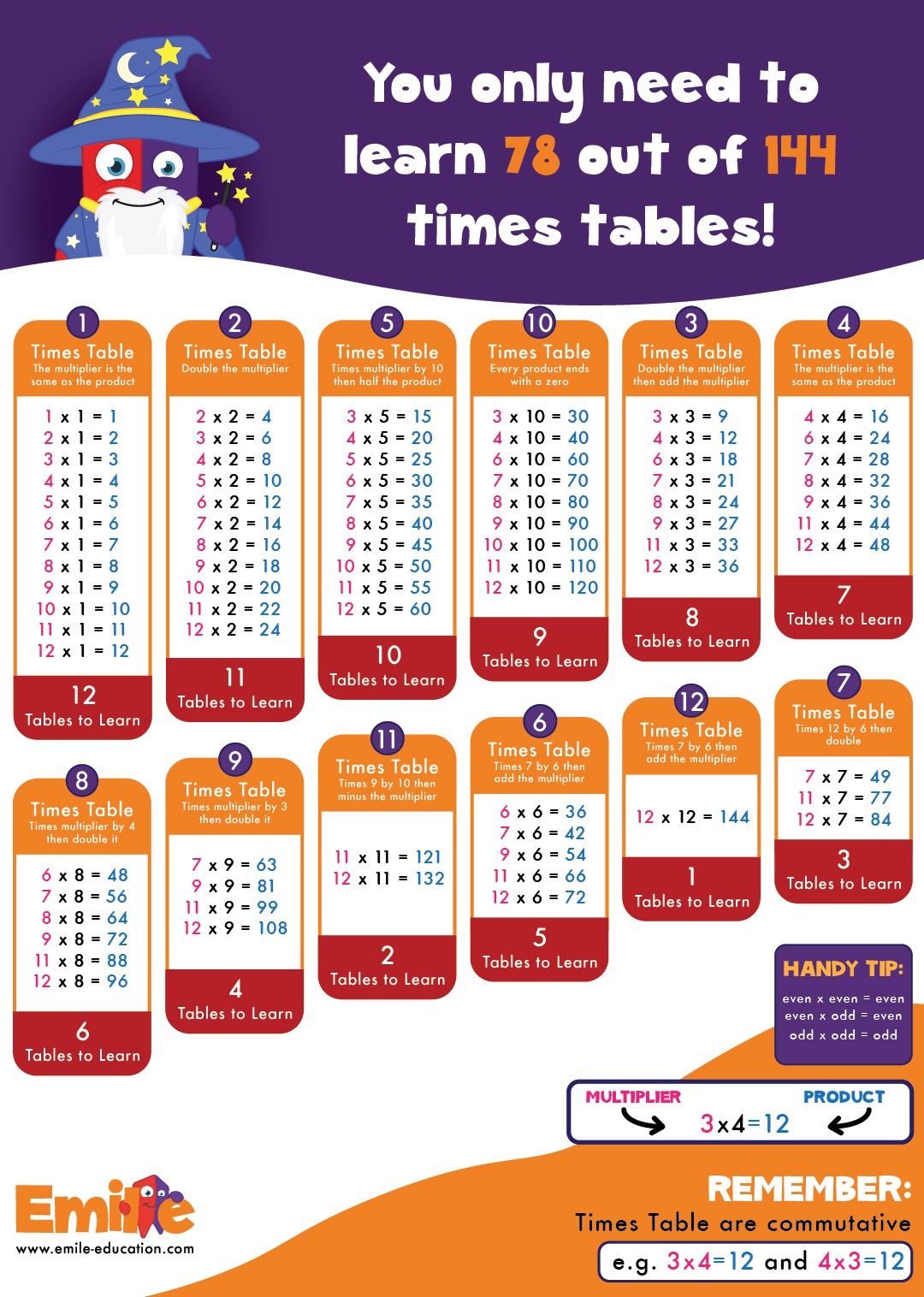
Commutativity: why 144 multiplication questions become 78 facts
A 12 by 12 multiplication grid contains 144 ordered calculations. It can look as though pupils must memorise 144 separate answers. Commutativity changes that picture: changing the order of the factors does not change the product. For example, 3 x 4 and 4 x 3 both equal 12.

How to teach commutativity without creating a shortcut misconception
- Teach the relationship with arrays: rotate a 3-by-4 array to show the same total as a 4-by-3 array.
- Practise both orientations orally and in writing, while explicitly naming them as one connected fact.
- Use fact-family cards to connect multiplication with division, such as 3 x 4, 4 x 3, 12 ÷ 3 and 12 ÷ 4.
- Highlight the diagonal square facts because they do not have a different partner.
- Use the reduced set to make learning feel manageable, but continue to present both orientations because either can appear in teaching and assessment.
- Do not describe 78 as the number of questions in the MTC. The check contains 25 questions; 78 describes the unique facts in the full 1-to-12 grid.
A practical “learn one, know two” routine
- Introduce one fact through an array or equal groups.
- Write the commutative partner alongside it.
- Say both facts aloud: “three fours are twelve; four threes are twelve”.
- Hide one orientation and retrieve the other.
- Mix the pair with previously secured facts.
- Revisit after a delay so the relationship becomes retained recall.
Suggested visual: the 78-fact learning poster
The supplied Emile poster turns the same principle into a pupil-facing reference. The poster groups the new facts by multiplier and reduces the apparent total from 144 to 78 by omitting commutative duplicates. It works best as an explanation and reference point, not as a substitute for retrieval practice.
The hardest combinations: navigating the 6, 7, 8 and 12 tables
These tables are often described as “harder”, but difficulty sits at fact level rather than belonging permanently to a whole table. A pupil may recall 8 x 5 immediately yet hesitate over 8 x 7. Heatmaps help teachers identify those exact combinations instead of repeatedly reteaching every fact.
High-value derived-fact strategies
- 6 x n: use 5 x n plus one more group, or double 3 x n.
- 7 x n: combine 5 x n and 2 x n while the fact is being established.
- 8 x n: double the 4 table, or double the 2 table twice.
- 12 x n: combine 10 x n and 2 x n, or double 6 x n.
- Use commutativity to reduce the number of genuinely new facts, connecting 7 x 8 with 8 x 7.
- Once a derived strategy is understood, practise direct retrieval so the strategy becomes a bridge rather than a permanent six-second calculation.
A focused difficult-fact routine
- Select three to five insecure facts from the heatmap.
- Rebuild meaning with arrays or equal groups where necessary.
- Link each fact to a secure fact.
- Practise the facts in both orientations.
- Mix them with secure facts to prevent pattern dependence.
- Recheck after several days and again after a longer interval.
Free MTC worksheets for accuracy and targeted practice
Once pupils understand how multiplication facts are connected, paper-based practice can help teachers check accuracy and identify particular facts that need further attention.
- short retrieval sessions
- identifying insecure multiplication facts
- intervention groups
- discussing derived-fact strategies
- checking accuracy before introducing timing
- homework where device access is limited
Remember: The statutory MTC is completed online and has strict time limits. Paper worksheets support multiplication knowledge and accuracy, but they should be used alongside appropriate experience of the digital layout, answer-entry method and six-second response period. [emile-education.com]
The three-stage progression: from counting on to understanding and instant recall
Pupils do not move from first exposure straight to automatic recall. A useful progression distinguishes a counting strategy, conceptual and derived understanding, and finally rapid retrieval. The stages overlap, and pupils may be at different stages for different facts.
| Stage | What it may look like | Teaching response | Readiness to move on |
|---|---|---|---|
| 1. Counting and building | Counts in equal steps, uses objects, draws groups or counts through a sequence. | Use concrete and pictorial representations; connect repeated addition to multiplication language. | Can represent the fact accurately and explain the equal groups. |
| 2. Conceptual and derived | Uses commutativity, doubling, 10 minus one group, or a known fact to derive another. | Make relationships explicit; compare strategies; practise accurate derivation. | Can derive the answer efficiently without rebuilding from one. |
| 3. Instant recall | Retrieves mixed facts accurately and consistently without counting through the table. | Use short, spaced, mixed retrieval; gradually introduce the MTC timing and digital input. | Retains the fact over time and across oral, written and digital contexts. |
A half-term-by-half-term times-tables teaching schedule
The schedule below is an illustrative whole-school mapping aligned with the national curriculum and the broad progression commonly used in schemes such as White Rose Maths. It is not a reproduction of White Rose Maths materials, and schools should map it against the current version of their purchased or adopted scheme before publication or implementation.
The sequence assumes that multiplication and division teaching sits within the wider mathematics curriculum. Retrieval continues across the year even when the main unit has moved on.
| Year and half term | New or priority content | Retrieval and assessment focus |
|---|---|---|
| Year 2 Autumn 1 | Equal groups, repeated addition and counting in 2s, 5s and 10s. | Oral counting, objects, arrays and vocabulary. |
| Year 2 Autumn 2 | Introduce multiplication and division symbols through grouping and sharing. | Connect representations to number sentences. |
| Year 2 Spring 1 | Develop the 2 table and related division facts. | Ordered facts, then selected facts out of sequence. |
| Year 2 Spring 2 | Develop the 5 and 10 tables and related division facts. | Compare patterns; connect 5 with half of 10. |
| Year 2 Summer 1 | Mix 2, 5 and 10 facts in problems and arrays. | Check accurate recall without intensive timing. |
| Year 2 Summer 2 | Consolidate 2, 5 and 10; address gaps before Year 3. | Short baseline-style review for transition. |
| Year 3 Autumn 1 | Revisit 2, 5 and 10; introduce the 3 table. | Check retention after the summer break. |
| Year 3 Autumn 2 | Introduce the 4 table through doubling the 2 table. | Mix 3 and 4 with secure earlier tables. |
| Year 3 Spring 1 | Introduce the 8 table through doubling relationships. | Use 2, 4 and 8 connections and related division. |
| Year 3 Spring 2 | Consolidate 3, 4 and 8; develop fact families and commutativity. | Begin brief low-pressure digital familiarity. |
| Year 3 Summer 1 | Apply known tables in calculation, fractions and measures. | Out-of-sequence recall and targeted gap work. |
| Year 3 Summer 2 | Secure 2, 3, 4, 5, 8 and 10 before transition. | Diagnostic assessment for Year 4 planning. |
| Year 4 Autumn 1 | Revisit prior tables; teach 6 and 9 using known relationships. | Baseline MTC-style check plus table-level diagnosis. |
| Year 4 Autumn 2 | Teach 7 and strengthen difficult 6, 7, 8 and 9 facts. | Half-termly check; targeted retrieval groups. |
| Year 4 Spring 1 | Teach 11 and 12; connect 12 with 6, 3 and 4. | Mixed recall across 2 to 12; accuracy before speed. |
| Year 4 Spring 2 | Consolidate all tables and related division facts. | Heatmap-led intervention and gradually timed practice. |
| Year 4 Summer 1 | Target individual facts; rehearse the statutory layout and input routine. | Occasional full checks; practise access arrangements; address rushing. |
| Year 4 Summer 2 | Complete the MTC, then apply fluency in wider mathematics. | Avoid post-check testing; plan transition gaps for Year 5. |
What constitutes a “good” score on the MTC?
There is no statutory pass mark, so “good” should not be reduced to a single threshold. A score is most useful when read alongside the pupil’s starting point, score distribution, fact-level errors, response speed and any access or input issues.
| Result pattern | What it may indicate |
|---|---|
| 25/25 | Complete accuracy in that administration of the statutory format. |
| High score with one or two repeated gaps | Generally secure recall with a small fact cluster still insecure. |
| Mid-range score with concentrated table gaps | Secure foundations but incomplete coverage or retention. |
| Accurate in class but lower in MTC format | Timing, device input, attention or familiarity may be affecting performance. |
| Low or static score | May reflect conceptual gaps, attendance, access, recall or multiple interacting barriers. |
For internal monitoring, schools may use the indicative month-by-month ranges in this guide, but they should label them clearly as school checkpoints rather than national standards.
Help parents understand the MTC
Clear communication with families can prevent the Multiplication Tables Check from becoming a source of unnecessary pressure. Parents and carers need to understand what the check involves, how long it takes, what pupils experience on screen and how they can support practice calmly at home.
- a free, editable MTC PowerPoint for Parents that schools can use during a parent meeting, information evening or online briefing.
- a downloadable parent letter
- example MTC worksheets.
The presentation and letter help schools explain:
- what the Multiplication Tables Check is
- when pupils complete it
- how the 25-question check works
- why pupils have six seconds for each question
- how the school is preparing pupils
- why there is no statutory pass mark
- how families can support recall without creating unnecessary pressure
- where parents can find further information and practice
How schools use MTC results and what gets reported to parents
MTC results should inform teaching rather than create a pass-fail label. Schools can use the score and question-level patterns to identify pupils who need further support, evaluate curriculum coverage, plan Year 5 transition and review differences between pupil groups.
Useful school actions after results
- Share pupil-level gaps with the Year 5 teacher.
- Continue targeted support where fluency remains insecure.
- Review whether class-wide patterns point to curriculum sequencing or teaching issues.
- Compare outcomes with internal assessments, noting differences in conditions.
- Evaluate participation, access arrangements and any technical incidents.
- Retain multiplication within wider calculation and reasoning rather than continuing a programme of MTC mocks.
What to communicate to parents and carers
- The pupil’s score out of 25, explained without calling it a pass or fail.
- A short explanation that there is no statutory pass mark.
- Relevant context, such as strengths, particular tables to revisit or progress from the school’s baseline.
- What the school will do next, especially where support is required.
- One manageable home focus, rather than a request to practise every table.
- A reminder that times-table fluency supports later work in division, fractions, ratio and calculation.
Example parent wording
“Your child scored 21 out of 25 in the Year 4 Multiplication Tables Check. There is no pass mark. The result shows secure recall across most tables, with a small number of 7 and 8 table facts to strengthen. We will continue to practise these in school and have included a short optional activity for home.”
What MTC score should a Year 4 pupil achieve each month?
The Department for Education does not publish an official month-by-month MTC trajectory. The ranges below are proposed internal checkpoints, not pass marks or national expectations. Schools should refine them using their own historic results, curriculum sequence and cohort starting points.
| Point in Year 4 | Indicative range | Leadership interpretation |
|---|---|---|
| September baseline | Dec-16 | Locate missing tables and distinguish knowledge from format issues. |
| End of October | 14-18 | Core Year 3 facts should be becoming increasingly secure. |
| End of December | 16-20 | Accuracy should improve across mixed tables. |
| End of February | 18-22 | Most facts should be known; analyse speed and consistency. |
| End of March | 20-23 | Pupils should be comfortable with the six-second rhythm. |
| End of April | 21-24 | Target individual facts; avoid indiscriminate repetition. |
| End of May | 22-25 | Prioritise confidence, consistency and careful input. |
| June check | Individual outcome | Keep routines calm and avoid last-minute cramming. |
A total score can hide very different needs. One pupil may have secure recall but make touchscreen errors. Another may be accurate but too slow. A third may have a concentrated gap in the 7 and 8 tables. A fourth may rush and press submit before checking. Effective assessment identifies which situation applies.
How often should schools assess MTC readiness?
Weekly formative information
Use lessons, learning games and brief retrieval to notice particular facts that cause difficulty. This should be low stakes and close to teaching.
Half-termly standardised checks
A full 25-question MTC-style assessment under consistent conditions gives a comparable checkpoint. Avoid turning every practice session into a full mock check. Use software which produces heatmaps like Emile or MTC Assessments.
Short targeted reassessment
After intervention, reassess the selected table or small fact set first. This establishes whether teaching has worked before the next scheduled full check.
Termly leadership review
- Cohort mean, median and score distribution.
- Movement since the previous standardised assessment.
- Pupil Premium and other relevant group patterns.
- Persistent weaknesses by table and individual fact.
- Accuracy compared with response speed.
- Evidence that interventions are followed by reassessment.
- Participation, confidence and completion.
From MTC score to teaching action: using heatmaps
A class average tells leaders whether performance is moving. It does not tell a teacher what to teach tomorrow. Heatmaps turn question-level results into a visual picture of table and fact security, making patterns easier to spot at pupil and class level.
Emile’s heatmaps track whether pupils answer multiplication facts correctly within six seconds. The published bands are green for 90-100%, yellow for 75-89%, orange for 50-74% and red for below 50%. Individual and whole-class views can therefore support a rapid move from reporting to action.

Questions a heatmap should answer
- Which tables are secure?
- Which individual facts are repeatedly incorrect?
- Is the issue widespread or concentrated?
- Are answers correct but too slow?
- Has an intervention produced retained improvement?
- Does a whole-class pattern indicate a curriculum or teaching issue?
How to target particular multiplication tables
A pupil scoring 18 out of 25 does not automatically need more of everything. They may need one table, four individual facts, slower and more careful input, or additional fluency practice. Use a five-step targeting cycle.
Identify the weakest table
Look for a concentration of errors, especially within the 6, 7, 8, 9 or 12 tables.
Identify the precise facts
Do not reteach a whole table if only 6 x 7, 7 x 7, 7 x 8 and 7 x 12 are insecure.
Diagnose the difficulty
Separate conceptual understanding, derivation, recall speed, digital input and rushing.
Match the intervention
Choose representations, structured table teaching, focused retrieval, gradually timed practice or input rehearsal according to need.
Reassess and check retention
Check the facts again after several days and later after a longer interval.
| Identified need | Appropriate response |
|---|---|
| Weak conceptual understanding | Arrays, equal groups, manipulatives and pictorial representations. |
| Whole table insecure | Structured teaching followed by sequential and then mixed practice. |
| Individual facts insecure | Focused retrieval of a small fact set. |
| Accurate but slow | Short, gradually timed retrieval after accuracy is established. |
| Digital input difficulty | Number-entry practice using the intended device. |
| Pupil rushes | Temporarily remove the submit button and reinforce checking. |
| Knowledge not retained | Spaced retrieval across days and weeks. |
| Several tables insecure | Prioritise prerequisite and related tables before harder facts. |
Worked example: heatmap-led intervention
A Year 4 class completes an MTC-style assessment and achieves an average of 18 out of 25. The headline appears reasonable, but the heatmap shows a concentration of errors in the 7 and 8 tables. Closer analysis identifies 7 x 8, 6 x 7, 8 x 8 and 8 x 12 as frequent errors.
The teacher does not ask every pupil to repeat another full assessment. Instead:
- The class revisits the relationship between the 4 and 8 tables.
- A smaller group receives explicit teaching on the 7 table.
- Pupils with only two insecure facts complete focused retrieval.
- Pupils who are accurate but slow receive brief timed activities.
- Pupils making input errors practise on the school’s intended device.
The selected facts are reassessed several days later and again after a longer interval. This checks retention rather than short-term familiarity.
A low-cost way to assess and track MTC readiness
Schools do not need a complicated data system. They need a consistent MTC-style experience, usable reporting and sufficient detail to identify the tables and facts that require attention.
MTC Assessment is a dedicated assessment option for schools: https://mtc-assessment.co.uk/
When positioning the service for publication, use “low-cost” rather than “cheap”. It communicates value without implying reduced quality. Verify current pricing and licence terms on the live website immediately before publishing, as commercial details can change.
- MTC-style pupil assessment.
- Individual and class-level reporting.
- Times-table heatmaps.
- Results that can support targeted teaching.
- Adjustable tables or timings where available.
- A practical option for regular school or trust checkpoints.
Turning assessment results into intervention
Assessment only has value when it changes what happens next. Once a heatmap identifies an insecure table or fact, pupils need an activity matched to that gap. Another full assessment is rarely the most efficient first response.
Using Emile’s learn games
Times Tables with Emile uses an Assess, Practise and Achieve model and includes learning games, representations, multiplayer activity and teacher-assigned work. It can support focused practice during intervention, class time or homework while giving teachers ongoing information about performance.
Learn games can be used to target particular weaknesses. The games are scaffolded and engaging.
High-impact MTC activities
A practical teaching sequence
Keep practice short and frequent. Present secure facts out of sequence, increase the frequency of insecure facts, mix oral, written and digital recall, and provide immediate feedback. Accuracy comes before speed.
MTC competitions
A well-designed competition can create a shared period of concentrated practice, increase participation and give teachers a rich, current dataset. Emile’s published MTC Cup account reports that the average daily score rose from 20.1 on the first day to 23.42 on the last day of the first round. The proportion scoring 25 out of 25 rose from 25.71% to 49.73%. These are results from that competition dataset, not a guaranteed outcome for every school.
Competitions should reward effort and progress as well as top attainment. Celebrate class participation, improvement and persistence. Avoid public comparisons that embarrass individual pupils or encourage frantic, inaccurate practice.
Familiarity with the MTC layout
Pupils should encounter the question position, answer box, six-second rhythm, pause, device and correction process before the statutory check. The aim is not to teach to the test. It is to prevent interface unfamiliarity from masking mathematical knowledge.
Helping pupils who go too fast
Rushing is an overlooked MTC problem. Pupils may type before reading fully, submit an incomplete answer or carry the rhythm of the previous question into the next one. A temporary “submit button off” mode can help establish a read, retrieve, enter and check routine before normal submission is reintroduced.
Accessibility options and arrangements for the MTC
Accessibility should allow a pupil to demonstrate multiplication-table recall without changing the knowledge being assessed.
Schools should plan arrangements early, base decisions on the pupil’s normal classroom practice and use the current Department for Education administration guidance for the relevant check year. Practice software can help pupils become familiar with settings, but a commercial platform’s options should not be assumed to be identical to the statutory service.
What does the official MTC guidance say about access arrangements?
The Standards and Testing Agency’s Multiplication tables check: administration guidance explains that access arrangements may be appropriate for pupils with specific needs who require additional arrangements to participate in the check. [gov.uk]
“Access arrangements may be appropriate for pupils with specific needs who require additional arrangements so they can take part in the MTC.”
- with an education, health and care plan
- with special educational needs and disabilities, with related provision and support in school
- whose learning difficulty or disability significantly affects their ability to access the check
- who have behavioural, emotional or social difficulties
- with English as an additional language and limited fluency in English
What criteria should schools apply?
Schools do not need to request permission to use the available access arrangements. However, the decision must reflect the pupil’s established needs and usual classroom provision.
“The support given should be based on normal classroom practice and must never advantage pupils.”
What MTC access arrangements are available?
Colour contrast
The standard check uses black text on a white background. Where colour contrast is enabled, pupils can choose from:
- yellow on black
- black on blue
- black on peach
- blue on cream [gov.uk]
Adjustable font size
A “Next” button between questions
The standard check has a three-second pause between questions. If that pace could disadvantage a pupil, the school can enable a“Next” button. The next question will not appear until the pupil selects it.
“This access arrangement does not extend the time given to answer each question.”
Removal of the onscreen number pad
Input assistance
“a person who enters answers dictated by the pupil.”
- cannot enter their own answers
- would experience physical discomfort when entering answers
- can enter answers only very slowly
- finds entering answers very difficult [gov.uk]
Audio version
The audio version reads aloud the instructions, questions and answer input. Pupils can use Tab and Shift + Tab to navigate through the elements on screen.
Audible time alert
Can pupils have additional time for each MTC question?
No. The official guidance is explicit:
“Pupils cannot be given additional time to complete the MTC questions, as this would remove the fluent recall element of the check.”
Leadership checklist for access arrangements
Before the administration window, leaders should confirm that:
- pupils have been considered individually
- each arrangement reflects normal classroom practice
- no arrangement gives an academic advantage
- the selected arrangements have been enabled in the MTC service
- pupils have used them in the official “try it out” check
- pupils will use an appropriate device and familiar input method
- check administrators understand the boundaries of adult assistance
- rooms provide sufficient space for individual or small-group arrangements
- any decision that a pupil will not participate has been made and recorded appropriately
When might a pupil not take the MTC?
The headteacher makes the final decision about participation. The guidance says pupils should not take the check if:
- they cannot participate even with access arrangements
- they cannot answer the easiest questions or are working below the Year 2 national curriculum expectation for multiplication tables
- they have arrived at the school during the check period and there has not been enough time to establish their abilities [gov.uk]
“they are unable to participate, even when using access arrangements”
- cannot answer the easiest questions, or are working below the national curriculum expectation for Year 2 multiplication tables
- have arrived at the school during the check period and there has not been enough time to establish their abilities
- is absent throughout the complete three-week check period
- has left the school
- appears on the school’s MTC register in error
Important: A pupil should not be recorded as not taking the check simply because the school expects a low score. The decision should be based on the statutory participation criteria and the pupil’s ability to access the check, including the available access arrangements.
What must the school record?
The pupil must remain on the MTC register. The school should use“Provide a reason why a pupil is not taking the check” within the MTC service and select the relevant pupil and reason.
- completed the check, or
- had a reason for not taking it recorded correctly.
What happens if a pupil is absent or newly arrived?
An absence during the main MTC administration period does not automatically mean that a pupil should be recorded as not taking the check. Schools have an additional week for pupils who were absent or whose check was delayed by technical difficulties.
- 1 to 12 June 2026: main MTC administration period
- 15 to 19 June 2026: additional period for pupils who were absent or whose administration was delayed by technical difficulties
- 19 June 2026: deadline for pupils to complete the check or be recorded with an appropriate reason for not taking it [gov.uk]
What if a pupil is absent during the main two weeks?
What if a pupil is absent for the full check window?
A short absence during the first two weeks is therefore not, by itself, a reason to record a pupil as not taking the MTC.
What happens when a pupil arrives during the check period?
“they have just arrived in school during the check period and there is not enough time to establish their abilities”
- assessment information transferred from the previous school
- evidence from classroom mathematics
- a short diagnostic assessment
- use of the official “try it out” check
- information about the pupil’s usual access arrangements
- confirmation of an appropriate device and input method
What if a pupil changes schools during the MTC window?
- the previous school should record the pupil as having left
- the receiving school should add the pupil to its register
- the receiving school must either administer the check or record an appropriate reason for the pupil not taking it
How does non-participation affect the class average?
A pupil who does not take the check does not receive an MTC score. For the school’s own class analysis, the pupil should therefore not be entered as zero.
Worked example
- 28 pupils take the check
- their combined score is 560
- 2 pupils have an accepted reason for not taking the check
What leaders should report together
Where pupils do not participate, report:
- the number of pupils registered
- the number who completed the check
- the number recorded as not taking the check
- the participation percentage
- the mean score for pupils with a valid result
- the percentage of participating pupils scoring 25/25
- the denominator used for every percentage
Of 30 registered pupils, 28 completed the MTC, giving a participation rate of 93.3%. The mean score among participating pupils was 20.0, and 8 of the 28 participating pupils, 28.6%, achieved 25/25.
What should school leadership expect?
Curriculum expectations
- Multiplication develops from Key Stage 1 rather than beginning in Year 4.
- The sequence moves from representations and relationships towards recall.
- Multiplication and division are connected explicitly.
- Retrieval is planned and revisited.
- Support begins before the final summer term.
Assessment expectations
- A baseline identifies specific gaps.
- Full checks happen at useful intervals, not constantly.
- Question-, fact- or table-level analysis informs teaching.
- Accuracy and speed are considered separately.
- Pupil Premium patterns are reviewed without lowering expectations.
- Intervention is followed by reassessment.
- Class averages are not used in isolation.
Classroom expectations
- Practice is short, purposeful and matched to need.
- Pupils work on appropriate tables and facts.
- The digital format is familiar but does not dominate teaching.
- Teachers adapt practice in response to current evidence.
- Pupils who rush receive support as well as pupils who answer slowly.
- Participation remains positive and proportionate.
| Stage | Priority actions |
|---|---|
| Year 2 | Develop 2, 5 and 10 table knowledge through equal groups, arrays and links to division. |
| Year 3 autumn | Check retention; teach 3, 4 and 8 systematically; begin mixed retrieval. |
| Year 3 spring/summer | Improve out-of-sequence recall; locate persistent gaps; introduce low-pressure digital familiarity. |
| Year 4 September | Run a diagnostic baseline; group needs by table and error type; establish retrieval routines. |
| Year 4 autumn | Teach remaining content; run a half-termly check; intervene on precise gaps. |
| Year 4 spring | Increase mixed and timed retrieval; consider a competition; monitor Pupil Premium progress. |
| Year 4 April/May | Use full checks sparingly; target individual facts; address rushing; confirm access arrangements. |
| Year 4 June | Keep routines calm and familiar; avoid last-minute cramming. |
FAQs About the Year 4 MTC
1. What is the Year 4 Multiplication Tables Check?
It is a statutory online check for eligible Year 4 pupils in England. Pupils answer 25 questions from the 2 to 12 multiplication tables.
2. When does the MTC take place?
It normally takes place during a Department for Education window in June. Schools should check the current year’s administration guidance for exact dates.
3. Is the MTC statutory?
Yes, for eligible pupils in maintained schools, special schools, academies and free schools in England, subject to the current guidance.
4. How many questions are in the MTC?
There are 25 multiplication questions.
5. How long does each question last?
Pupils have six seconds to enter an answer, followed by a three-second pause.
6. Which tables are included?
Questions are drawn from the 2 to 12 multiplication tables.
7. Is there a pass mark?
No statutory pass mark is set. Schools receive a score out of 25.
8. How long does the complete check take?
The standard 25-question sequence lasts approximately three minutes and 45 seconds, including pauses.
9. Can pupils practise the format?
Yes. Familiarity with the device, answer box and timing can reduce format-related errors, but it should complement rather than replace curriculum teaching.
10. What happens if a pupil is absent?
Follow the current administration guidance and use another day within the official window where permitted.
11. What is a good MTC score?
There is no official pass mark. Interpret the score against the pupil’s starting point, the school’s trajectory and the specific facts missed.
12. What should pupils score in September?
A proposed baseline range is 12-16, but this is an internal planning guide rather than a national expectation.
13. What should pupils score by Christmas?
A proposed internal checkpoint is 16-20, adjusted for curriculum sequence and cohort starting point.
14. What should pupils score by Easter?
A proposed internal checkpoint is around 20-23 by the end of March, but table-level security matters more than the headline alone.
15. How can schools tell whether pupils are on track?
Use comparable half-termly checks, question-level analysis, heatmaps, classroom evidence and progress from baseline.
16. How often should teachers run a full assessment?
Half-termly is a practical starting point. Use shorter targeted checks between full assessments.
17. Should every pupil achieve 25 out of 25?
Full marks can be celebrated, but it should not be the only definition of progress or success.
18. How should leaders analyse results?
Review mean, median, distribution, movement over time, group patterns, table-level weaknesses and the effect of intervention.
19. How should Pupil Premium outcomes be compared?
Use the same assessment conditions and examine access to practice, attendance, starting points and the score distribution as well as the mean.
20. What if a pupil’s score stops improving?
Re-diagnose. The pupil may need conceptual teaching, a smaller fact set, more spaced practice, input support or help to slow down.
21. What should pupils know by the end of Year 2?
They should develop recall and use of the 2, 5 and 10 tables alongside equal grouping, arrays and related division.
22. What should pupils know by the end of Year 3?
They should maintain 2, 5 and 10 and develop the 3, 4 and 8 tables, including inverse and commutative relationships.
23. What should pupils know before Year 4?
They should understand multiplication structures and possess increasingly reliable recall of the tables already taught. This should include 1, 2, 10, 5, 3, 4, & 6 times tables.
24. What is the most effective way to teach recall?
Follow a coherent scheme, teach relationships explicitly, establish accuracy, then build automaticity through short, spaced and mixed retrieval.
25. How much practice is appropriate?
Short, frequent practice is generally more useful than occasional long sessions. The exact amount should respond to need without narrowing the curriculum.
26. Should practice be in order or mixed?
Use ordered practice when a table is being established, then move to mixed and out-of-sequence retrieval.
27. How can pupils answer within six seconds?
Build secure knowledge first, then introduce gradually timed retrieval. Avoid using speed to compensate for knowledge that is not yet established.
28. How can teachers help pupils who rush?
Temporarily remove the submit button where software permits, teach a checking routine and analyse whether errors are knowledge or input related.
29. What access arrangements are available?
Schools must use the current official guidance. Potential arrangements depend on normal classroom practice and pupil need; they should not change what is being assessed.
30. How can competitions help?
They can concentrate practice, create a shared goal and increase participation. Design them to reward effort, improvement and teamwork as well as high scores.
Source and editorial notes
Use these links during final fact-checking and publication. Commercial details, statutory dates and access arrangements should always be checked against the current live pages and official guidance.
