
How to Choose a Grammar Scheme for Primary Schools
A practical guide to terminology, retrieval, curriculum progression, SATs preparation and application in writing.
Written for UK primary teachers, English leads, literacy coordinators and school leaders.
Table of Contents
A grammar scheme should be judged by what pupils remember, understand and apply, not by the number of terms it introduces.
Choosing a grammar and punctuation scheme is a curriculum decision, a subject-knowledge decision and a workload decision.
A programme may introduce every statutory term yet leave pupils unable to recognise grammatical structures in unfamiliar sentences.
Another may provide engaging worksheets but give teachers little help in building knowledge progressively from Year 1 to Year 6.
The right question is therefore not simply:
“Does this scheme cover Appendix 2?”
"Will this help pupils retrieve, understand and apply grammatical knowledge confidently?”
An effective grammar scheme should give teachers a coherent progression, accurate explanations, carefully chosen examples and regular opportunities for pupils to revisit, discuss and apply their knowledge. It should also help teachers identify misconceptions without creating an additional planning and marking burden.
This guide explores the terminology challenge, statutory curriculum expectations, the place of retrieval practice, mixed-age teaching, preparation for the KS2 grammar, punctuation and spelling test, assessment and implementation.
The Grammar Terminology Challenge
The National Curriculum grammar appendix sets out a substantial body of vocabulary, grammar and punctuation content from Year 1 to Year 6. The terminology begins with familiar ideas such as letter, word, sentence, singular, plural and full stop. It then develops through noun phrase, conjunction, clause, determiner and adverbial to concepts including modal verb, relative clause, cohesion, ambiguity, subject, object, active, passive and ellipsis.
These are not optional labels. Pupils are expected to recognise and use the terminology through discussion and practice. The curriculum also makes clear that concepts are listed in the year in which they should first be introduced, not the year in which they should be considered completely understood. Earlier content therefore needs to be revisited in later years.
Source note: Department for Education, English Appendix 2: Vocabulary, grammar and punctuation.
The difficulty is cumulative
A Year 6 pupil cannot securely understand the passive voice without understanding verbs, clauses, subjects and objects.
Similarly, a pupil is unlikely to understand how a relative clause works if noun phrases, pronouns and clauses remain insecure.
Grammar knowledge is connected. When an earlier concept is missing or misunderstood, later terminology can become a collection of definitions rather than a usable system.
• The prerequisite knowledge behind each concept;
• How terminology connects across the curriculum;
• When earlier content will be revisited;
• Which misconceptions teachers should expect;
• How pupils move from recognition to explanation and application; and
• How grammatical knowledge supports reading and writing.
How Much Grammatical Terminology Should Pupils Learn?
The challenge is not simply deciding whether grammatical terminology should be taught. Schools also need to decide which terms pupils genuinely need, when each term becomes useful and how deeply pupils should understand it.
If pupils learn too little terminology, teachers and pupils lack a precise shared language for discussing sentences and improving writing. If pupils learn too many overlapping classifications, grammar can become an exercise in naming categories that pupils rarely use.
A well-designed grammar scheme should distinguish between:
- Essential statutory terminology that every pupil needs;
- Supporting terminology that clarifies an important concept;
- Extension terminology that may be useful for some pupils or contexts; and
- Specialist linguistic terminology that belongs primarily in teacher guidance or later study.
An example: what types of pronoun should be taught?
Pronouns illustrate the difficulty.
There are many types of pronouns but only a few feature in the national curriculum. Why?
The current English curriculum explicitly names personal pronouns, possessive pronouns, indefinite and relative pronouns.
Demonstrative pronouns are also usually taught in most grammar schemes.
This leaves interrogative, reciprocal and reflexive pronouns as missing.
The principle: Teach terminology to the depth at which it becomes useful. A term earns curriculum time when it helps pupils understand sentence structure, punctuation, meaning, cohesion, editing or purposeful language choices.
Tier 1: the basics
- Personal pronouns: I, me, you, he, him, she, her, it, we, us, they and them. Pupils should understand reference, subject and object forms, person consistency and clear antecedents.
- Possessive pronouns: mine, yours, his, hers, ours and theirs. Pupils should distinguish these from possessive determiners such as my, your, our and their.
- Relative pronouns and relative words: who, which, whose, that, where and when, together with omitted relative elements. Teaching should focus on how the relative clause relates to a noun or noun phrase.
Tier 2: intermediates
- Demonstrative pronouns: this, that, these and those. These are particularly useful for comparing pronoun and determiner functions.
- Indefinite pronouns: someone, anyone, everyone, nobody, something, each, several and many. Teach common examples where they support agreement, cohesion and clarity.
Tier 3: extensions
- Interrogative pronouns such as who, what and which can be named where the category clarifies question formation.
- Reciprocal pronouns, each other and one another, can be explained when encountered without requiring substantial discrete teaching.
- Reflexive pronouns: myself, yourself, himself, herself, itself, ourselves, yourselves and themselves. Teach where these support accurate usage and editing.
Why Knowing the Label Is Not Enough.
A pupil may be able to repeat that an adjective describes a noun but still identify almost any interesting word as an adjective. Another may underline a fronted adverbial in a familiar worksheet but fail to recognise one when its length, position or construction changes.
Grammar learning involves several levels of understanding:
| Stage | Question | |
|---|---|---|
| 1 | Recall | Can the pupil remember the term? |
| 2 | Recognition | Can the pupil identify the feature in a sentence? |
| 3 | Explanation | Can the pupil explain how the feature functions? |
| 4 | Comparison | Can the pupil distinguish it from a similar construction? |
| 5 | Manipulation | Can the pupil change or construct a sentence using it? |
| 6 | Application | Can the pupil use the knowledge purposefully in independent writing? |
A strong grammar scheme should plan for all six. Terminology matters because it gives pupils a shared language for analysing, discussing and improving writing, but the terminology should not become an end in itself.
What Does the Research Say About Teaching Grammar?
Grammar teaching has a contested history. The evidence does not support the simple proposition that teaching more terminology or completing more isolated exercises will automatically improve pupils’ writing. It does, however, offer useful principles for designing explicit teaching that connects grammatical knowledge with meaning, discussion and application.
1. Contextualised grammar and writing
Research led by Debra Myhill and colleagues at the University of Exeter examined grammar teaching embedded within writing instruction. Grammatical concepts were connected to meaning, effect and the choices made by writers, rather than presented only as rules or labels.
2. The limits of decontextualised grammar
A major UK systematic review led by Richard Andrews found no convincing evidence that traditional, decontextualised syntax teaching improves the quality or accuracy of pupils’ writing. This is not an argument against explicit grammar teaching. It is a warning that terminology and exercises alone do not guarantee transfer into composition.
3. Metalinguistic discussion
Work by Myhill and colleagues also highlights metalinguistic talk: pupils and teachers using a shared language to explain, compare and evaluate choices. The value of a recap is therefore not only the questions on the slide, but the teacher discussion, justification and diagnosis that the questions make possible.
What the Evidence Means in Practice.
Teach terminology explicitly, but do not stop at definitions. Use complete sentences. Revisit knowledge cumulatively. Ask pupils to explain and compare. Connect structures to meaning and purpose. Preserve teacher discussion. Assess transfer as well as identification.
Source note: Myhill, Jones, Lines and Watson (2012), Re-thinking grammar; Andrews et al. (2006), The effect of grammar teaching on writing development; Education Endowment Foundation, Grammar for Writing first and second trials.
What Makes an Effective Grammar and Punctuation Scheme?
A strong grammar scheme does not treat curriculum coverage as a checklist. It organises knowledge so that pupils repeatedly retrieve earlier concepts, connect them with new learning and apply them in increasingly demanding contexts.
| Area | What good provision looks like |
|---|---|
| Curriculum | A transparent Year 1 to Year 6 progression mapped to statutory content. |
| Terminology | Accurate, consistent explanations supported by examples and non-examples. |
| Retrieval | Planned recaps that revisit terminology, patterns and punctuation from earlier learning. |
| Context | New terminology introduced through complete sentences, examples and discussion. |
| Instruction | Explicit explanation, modelling, questioning and guided sentence analysis. |
| Application | Tasks that require pupils to classify, construct, manipulate, correct and edit. |
| Writing | Clear links between grammatical knowledge and purposeful written choices. |
| Assessment | Checks that distinguish forgotten terminology from deeper misconceptions. |
| Mixed-age teaching | Complementary Year 3/4 and Year 5/6 content that enables shared input with appropriate challenge. |
| Implementation | Ready-to-teach resources, consistent routines and manageable lesson expectations. |
| Subject knowledge | Detailed, premade but adaptable resources that protect terminology consistency, explain reasoning and support teachers with different levels of confidence. |
Three-Parts Per Week Structure
Grammar and punctuation involve a large number of connected terms, patterns and conventions. Pupils are unlikely to retain this knowledge if concepts are taught once and revisited only during assessment.
Emile divides the teaching sequence into three distinct parts. Each has a different purpose. Together, they help pupils move from remembering terminology to understanding and using it.
Retrieve it. Understand it. Apply it.
1. RECAP
Retrieve and strengthen previously taught terminology, patterns and punctuation.2. WHOLE-CLASS INPUT
Introduce or revisit the week’s concept through explicit explanation and meaningful sentence contexts.3. ACTIVITY
Consolidate understanding through flexible tasks, challenges and application.1. Recap: retrieve and strengthen existing knowledge
The recap brings previously taught knowledge back into pupils’ working memory. Rather than reviewing only the week’s topic, pupils encounter a purposeful mixture of terminology, sentence analysis and punctuation.
- Identify and classify nouns;
- Distinguish singular and plural forms;
- Find a verb and identify its tense;
- Recognise adjectives, adverbs and prepositions;
- Correct errors in a sentence; and
- Punctuate direct speech.
The example Year 5 recap revisits nouns, verb tense, prepositions, adjectives, apostrophes and direct-speech punctuation within one sequence. Answers are revealed progressively, allowing the teacher to pause, question pupils and discuss misconceptions rather than simply display a completed answer.
The Emile grammar scheme guidance suggests up to approximately 15 minutes for the recap so that teachers have time to use pupils’ responses as points for discussion.
Why it matters:
Retrieval is not simply repetition. Each recap gives pupils another opportunity to reconnect terminology with real examples and to reveal knowledge that needs further teaching.
2. Whole-class input: introduce new terminology in context
Once relevant prior knowledge has been activated, the whole-class input introduces or develops the week’s grammar focus. New terminology becomes more meaningful when pupils can see how it operates within a complete sentence.
• What the term describes;
• Where the feature appears;
• How it functions;
• How it changes a sentence;
• How it connects with familiar terminology; and
• How a speaker or writer might use it.
For example, pupils studying noun types might begin with a complete sentence, identify the nouns and then classify each one as common, proper, abstract or collective. The same sentence can subsequently support discussion of number, determiners, adjectives, verbs and prepositions.
The Emile grammar scheme suggests up to approximately 15 minutes for whole-class input each week, with activities that work through pupils’ understanding of one defined topic.
The principle:
Context turns a grammatical label into usable knowledge.
3. Activity: consolidate and check understanding
After pupils have retrieved relevant prior knowledge and explored the new concept, they need to do something with it. The activity stage allows pupils to confirm and demonstrate understanding through tasks on Emile, shared codes or Aimee’s Challenges. The teacher can vary the duration and level of support according to the class.
• Sort examples and non-examples;
• Label parts of sentences;
• Choose the most accurate explanation;
• Construct a sentence containing a specified feature;
• Combine or rearrange clauses;
• Correct punctuation;
• Compare two grammatical choices; and
• Edit a sentence for clarity or apply the concept in short writing.
An incorrect answer can indicate a forgotten term, confusion between two categories or a misunderstanding of the whole sentence. Those are different learning gaps and require different responses.
A Coherent Year 1 to Year 6 Progression
Effective progression is not simply a list of topics assigned to year groups. It should show how concepts depend on earlier knowledge and where retrieval and consolidation are deliberately planned.
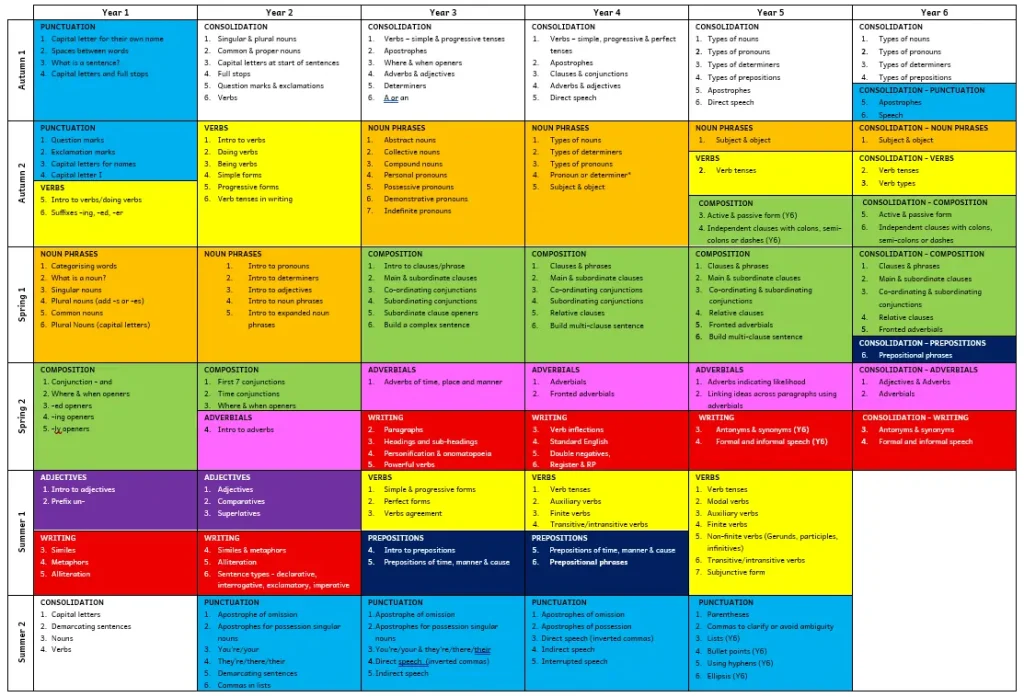
Emile’s progression begins with sentence demarcation, nouns, verbs and simple composition in Year 1. It then expands through pronouns, determiners, noun phrases, verb forms, clauses, conjunctions, adverbials and increasingly sophisticated punctuation. In upper Key Stage 2, pupils revisit and extend this knowledge through subject and object, relative clauses, modal and auxiliary verbs, active and passive constructions, cohesion, formal language and punctuation choices.
The progression map places consolidation at key points in Years 2 to 6. This supports cumulative learning rather than assuming that a term is secure because it appeared in an earlier year group.
Designed for Mixed-Age Classes
Mixed-age planning should not require teachers to deliver two entirely separate grammar lessons.
Emile’s progression has been designed so that the content for Years 3 and 4 complements across lower Key Stage 2, while the content for Years 5 and 6 complements across upper Key Stage 2. This gives teachers a practical foundation for shared whole-class teaching.
• Begin with a shared recap of relevant terminology;
• Introduce a connected concept through whole-class input;
• Vary questioning and scaffolding according to prior knowledge; and
• Use age-appropriate activities to consolidate and extend understanding.
For example, Year 3 introduces clauses, main and subordinate clauses, co-ordinating and subordinating conjunctions and complex sentence construction. Year 4 revisits these foundations and extends them through relative clauses and multi-clause sentences. Years 5 and 6 similarly use consolidation and extension to support shared teaching without expecting every pupil to complete identical work.
Where Does a Grammar Scheme Fit with Writing?
Grammar and writing should not be treated as competing curriculum choices. Pupils benefit from focused grammar teaching because concepts such as clause, determiner, subject, object, modal verb and relative clause require accurate explanation, carefully selected examples and planned retrieval. However, knowing the terminology does not automatically mean that pupils can use the knowledge when composing or editing.
A grammar scheme should therefore have a distinct teaching role while remaining connected to the school’s writing curriculum.
Why focused grammar teaching is useful
A focused grammar session gives teachers time to isolate a concept before pupils meet the additional demands of extended composition. It can be used to:
- Activate prerequisite knowledge;
- Explain terminology precisely;
- Model how a construction works;
- Compare examples and non-examples;
- Address common misconceptions;
- Manipulate sentences without the additional demands of extended writing; and
- Check whether pupils understand the concept.
This is particularly important for cumulative knowledge. Pupils are unlikely to understand the passive securely if verbs, clauses, subjects and objects remain uncertain.
Why grammar should not remain separate
Writing requires pupils to generate ideas, select vocabulary, construct sentences, maintain coherence, transcribe accurately and consider the reader at the same time. A pupil may recognise a grammatical feature in an isolated activity but still be unable to use it independently or decide whether it improves the writing.
Sentence Construction: The Bridge Between Grammar and Composition
Sentence construction is where focused grammar teaching and composition meet. The strongest tasks do not simply ask pupils to underline or label a feature. They ask pupils to make decisions about sentences.
- Construct a sentence from specified components;
- Combine two clauses;
- Change the position of an adverbial;
- Replace a noun phrase with a pronoun;
- Alter active to passive;
- Change the tense while maintaining agreement;
- Compare two punctuation choices;
- Revise a sentence for clarity; and
- Explain which construction best suits the intended meaning.
These tasks reduce the cognitive demands of extended composition while allowing pupils to practise the decisions writers make.
A worked example: fronted adverbials
Fronted adverbials illustrate why identification alone is insufficient.
| Depth | Example |
|---|---|
| Recognition | Identify the adverbial and recognise that it appears before the main clause: “After the final bell, the pupils left the classroom.” |
| Function | Explain whether the adverbial contributes information about time, place, manner, frequency, reason, condition or viewpoint. |
| Construction | Create or select a suitable example: “Without any warning, the lights went out.” |
| Manipulation | Compare positions: “Before sunrise, the expedition began” and “The expedition began before sunrise.” Discuss emphasis and flow. |
| Application | Decide whether the adverbial helps establish a setting, organise information, connect ideas or guide the reader. |
| Evaluation | Identify awkward or unnecessary accumulation: “With great excitement, the excited children cheered excitedly.” |
The purpose is not to make every sentence begin with a fronted adverbial. It is to help pupils use adverbials where they add useful information, cohesion or emphasis. The Government’s response to the Curriculum and Assessment Review similarly notes that fronted adverbials can add richness and depth, but can produce cluttered or fussy sentences when used without sufficient understanding.
Connecting Grammar Progression with Writing Units.
The grammar scheme does not need to dictate the school’s complete writing curriculum. It should provide usable knowledge that teachers can connect selectively to the texts and purposes being studied. For example:
Narrative writing
- Noun phrases for precise character and setting detail;
- Verb choices for action and pace;
- Adverbials for time and place;
- Pronouns and nouns for clear reference;
- Tense consistency;
- Clause structures for pace and emphasis; and
- Punctuation for dialogue.
Explanation writing
- Present tense;
- Causal and temporal conjunctions;
- Passive constructions where the process matters more than the agent;
- Pronoun reference;
- Technical noun phrases; and
- Paragraph cohesion.
Persuasive writing
- Modal verbs for degrees of certainty and obligation;
- Sentence types for emphasis;
- Pronouns that establish a relationship with the reader;
- Conjunctions that organise arguments; and
- Punctuation that clarifies complex points.
Should the two curricula be perfectly aligned?
Close alignment is useful, but rigid week-by-week matching is not always desirable. A grammar progression is organised around conceptual dependencies; a writing curriculum may be organised around texts, purposes and genres. Those sequences will not always coincide exactly.
A workable school model has three layers:
- Grammar progression: prerequisite concepts are introduced and revisited coherently.
- Sentence-application layer: every grammar unit includes construction, manipulation or editing.
- Writing connection: teachers identify appropriate opportunities to apply current and previously taught grammar within writing units.
This gives schools coherence without requiring two disconnected English curricula or distorting writing units to match a grammatical timetable.
Where Does Oracy Fit with Grammar?
Oracy is not an optional stage after grammar has been taught. It is one of the main ways pupils retrieve, rehearse, explain and demonstrate grammatical understanding.
The Education Endowment Foundation describes oral-language approaches as purposeful use of speaking, listening and verbal interaction. Its evidence summary reports that oral-language approaches are strongest when integrated with the existing curriculum. Much of the measured impact concerns reading comprehension rather than grammar specifically, so the evidence should support classroom design rather than be treated as proof that oracy activities alone improve grammatical attainment.
Oracy within the recap
- Give an answer before it is revealed;
- Explain how a word or construction was identified;
- Justify a classification;
- Compare two possible interpretations;
- Correct a sentence orally; and
- Use the relevant terminology in a complete explanation.
Instead of asking only “Which word is the preposition?”, a teacher might ask: “Which word is functioning as the preposition, and what relationship does it express?” This turns retrieval into metalinguistic discussion.
Oracy within whole-class input
- Teacher thinks-aloud;
- Oral sentence rehearsal;
- Paired explanation;
- Sentence stems;
- Comparison of alternative sentences;
- Oral substitution; and
- “Say it, change it, explain it” routines.
For example, pupils can alter “The robot moved through the tunnel” orally by substituting across, towards, beyond, after lunch or because of the alarm, then explain how each change affects the relationship or meaning expressed.
Oracy within the activity
• Construct a sentence orally before recording it;
• Explain why an answer is correct;
• Compare independently constructed sentences;
• Rehearse a clause before combining it with another;
• Explain an editing choice; and
• Evaluate whether a grammatical feature improves clarity.
This can help a teacher distinguish between a pupil who understands the concept but struggles with transcription, a pupil who can imitate a pattern but cannot explain it, and a pupil who has misunderstood the grammatical idea.
Does Oracy Fit Every Grammatical Concept?
Yes, but not in exactly the same way. Grammar describes patterns and choices in spoken as well as written language, while punctuation and layout belong specifically to written representation.
Strong transfer between speech and writing
- Sentence and clause construction;
- Noun and pronoun reference;
- Verb tense and agreement;
- Conjunctions and modal verbs;
- Active and passive constructions;
- Standard English forms;
- Formal and informal register;
- Cohesion; and
- Ambiguity
Concepts requiring an explicit writing connection
- Capital letters and apostrophes;
- Commas and inverted commas;
- Colons and semi-colons;
- Brackets and dashes;
- Paragraphing; and
- Layout devices.
Oracy still supports the reasoning behind written conventions. Pupils can discuss where a reporting clause ends, which words were spoken, whether one clause explains another and where the reader needs a boundary. Pupils must then see and produce the written form.
Recognising spoken grammar
Speech is not simply imperfect writing spoken aloud. Spoken language commonly includes contractions, repetition, reformulation, context-dependent fragments, changes of direction, interactional phrases and emphasis through stress and intonation. When teaching Standard English, schools should help pupils select language appropriate to context without presenting familiar spoken varieties as inherently deficient.
The Curriculum and Assessment Review recommends clearer requirements for speaking and listening and a new oracy framework, alongside a stronger emphasis on grammar in use. This makes oracy a natural part of future-facing grammar provision.
How Much Class Time Does a Grammar Scheme Need?
Primary timetables are already full. Schools need to protect time for reading, writing, spelling, handwriting, mathematics and the wider curriculum, while also meeting pupils’ intervention needs. A grammar scheme should bring coherence to this timetable, not create a second English curriculum competing for space.
A manageable weekly structure
Emile’s current public guidance proposes three short elements each week: recap, whole-class input and a short writing or consolidation activity. Each element should take no more than approximately 15 minutes, giving a planned weekly commitment of up to 45 minutes that can be distributed across the week or combined into one focused session.
Protecting writing time
A grammar scheme should not reduce the time pupils spend planning, composing, revising and discussing complete texts. Short focused sessions can protect writing time by explaining difficult concepts efficiently, providing shared terminology and addressing misconceptions before pupils compose.
Use time proportionately
Not every term needs a full lesson, worksheet, game, intervention and writing outcome. Foundational concepts such as sentence boundaries, verbs, tense, noun phrases, pronoun reference, phrases, clauses, subject and object deserve repeated attention because later learning depends on them. Narrower labels can be introduced briefly, revisited through recaps or retained mainly as teacher knowledge.
A manageable commitment:
Short enough to fit a crowded timetable. Structured enough to build cumulative knowledge. Flexible enough to connect with writing.
Gamifying Grammar Practice
Grammar requires repeated encounters. Pupils need to retrieve terminology, recognise features in varied sentences, distinguish similar concepts and apply knowledge accurately. Gamification can make this repeated practice more engaging by giving pupils clear goals, immediate feedback, visible progress and reasons to return to earlier learning.
Gamification should not replace explicit teaching. Points, trophies, characters and competitions are useful only when the grammatical thinking remains central.
Within Emile, games support the activity and consolidation stage after terminology has been retrieved and taught. The current offer includes assignable grammar games, pupil battles, class competitions, school competitions, trophies, ranks, characters and virtual rewards. Activities can be used for classwork, homework and targeted intervention.
What effective grammar gamification should do
- Retrieve previously taught terminology;
- Present the same concept through varied sentences and question forms;
- Give immediate feedback and opportunities to correct errors;
- Move pupils towards appropriately challenging examples;
- Revisit knowledge that remains insecure;
- Recognise effort and improvement as well as attainment; and
- Generate response evidence that can inform teaching.
Keep the learning goal visible
Each game or task should be connected to a defined grammatical concept, such as distinguishing pronouns from determiners, recognising main and subordinate clauses, using apostrophes for possession, selecting modal verbs or identifying active and passive constructions.
Repeated practice should not mean answering an identical question with superficial changes. Variation helps reveal whether a pupil understands the concept or has memorised a familiar question format.
Immediate and informative feedback
Pupils should know when an answer is incorrect while the grammatical decision is still fresh. Where possible, feedback should direct attention to the concept rather than display only a score. For example, a prompt might ask pupils to reconsider whether those is replacing a noun or introducing one. This supports the distinction between a demonstrative pronoun and a determiner.
Grammar Battles: Fun Grammar Assessment and Consolidation
“Grammar battles” are a useful, teacher-friendly way to describe short class competitions that turn cumulative review into an anticipated part of the grammar scheme. The battles should be positioned as low-stakes consolidation and formative assessment, not as a substitute for teacher assessment or as a public ranking of grammatical ability.
Battle 1: midpoint diagnostic
The first battle can take place after pupils have completed several recap, input and activity cycles. It should mix current content with prerequisite knowledge and earlier terminology.
• Purpose: identify concepts that need more teaching before the half term ends;
• Content: recent learning plus cumulative retrieval from earlier units;
• Teacher action: review class patterns, verify misconceptions and adapt subsequent recap or intervention work;
• Pupil experience: a short, energetic class competition with recognition for participation, improvement and accurate responses.
Battle 2: end-of-half-term consolidation
The second battle can revisit the half term’s principal concepts after teachers have had time to respond to the first set of results.
- Purpose: strengthen retrieval and check delayed retention;
- Content: a balanced mix of terminology, recognition, discrimination and sentence-level accuracy;
- Teacher action: identify knowledge to carry into the next half term’s recaps;
- Pupil experience: a celebratory consolidation event rather than a high-stakes test.
From Games to Detailed Grammar Gap Analysis
Every response can provide evidence about what a pupil currently understands. A conventional score might show that a pupil answered 14 out of 20 questions correctly. A useful grammar gap analysis should go further by indicating which knowledge is insecure and what kind of error may be occurring. Reports should support targeted work and intervention.
Turning Diagnostic Information into Teaching Action
Gap analysis is valuable only when it leads to a proportionate response.
At pupil level
- Assign practice on one identified concept;
- Provide a short teacher-led intervention;
- Revisit prerequisite terminology;
- Give a sentence-construction task; or
- Check the apparent gap in independent writing.
At group level
- Run a short guided session;
- Contrast examples and non-examples;
- Model the concept again; or
- Use a focused editing activity.
At class level
- Revisit whole-class input;
- Change or expand the examples used;
- Reteach prerequisite knowledge; or
- Adjust the progression before moving on.
Interpreting the Data Responsibly
Not every incorrect response represents a confirmed knowledge gap. An error may result from misreading, unfamiliar vocabulary, weak reading fluency, guessing, loss of attention, rushing, difficulty using the device or accidental selection.
- Look for patterns across several questions and sessions;
- Consider the number and range of responses completed;
- Check oral explanation and sentence construction;
- Compare game evidence with written work;
- Consider whether timers or reading demands affected performance; and
- Use additional care when interpreting data for pupils with SEND or pupils learning English as an additional language.
Automatically marked questions can provide useful detail about recall, recognition, discrimination and sentence-level accuracy. They do not replace professional judgement about explanation, composition or independent writing.
Assessment, Gap Analysis and Intervention
Assessment is most useful when it identifies the nature of a misunderstanding, not merely the number of incorrect answers.
- Has the pupil forgotten the term?
- Can the pupil recall the definition but not recognise the feature?
- Is the pupil confusing two related concepts?
- Can the pupil identify the feature but not explain its function?
- Can the pupil use the concept in a task but not in independent writing?
Emile activities can support assessment and generate pupil-level learning-gap information in the teacher portal. This can help teachers select targeted intervention activities rather than reteach an entire unit to every pupil.
Year 6 SATs: What the Grammar Test Actually Covers
The current Key Stage 2 English grammar, punctuation and spelling test has two papers: Paper 1 contains 50 marks of grammar, punctuation and vocabulary questions, while Paper 2 contains 20 spelling marks. Paper 1 allows 45 minutes.
The 2024, 2025 and 2026 mark schemes organise Paper 1 through seven content domains: grammatical terms and word classes; functions of sentences; combining words, phrases and clauses; verb forms, tense and consistency; punctuation; vocabulary; and Standard English and formality.
Topics that repeatedly appear
Across the 2024–2026 papers, pupils repeatedly meet questions requiring them to identify, select, transform or punctuate complete sentences. Recurring areas include:
- Word classes and grammatical terminology;
- Questions, statements, commands and exclamations;
- Phrases, clauses, conjunctions and sentence combining;
- Verb tense, agreement and consistency;
- Standard English and formal vocabulary;
- Synonyms, antonyms, prefixes and suffixes;
- Pronouns, determiners, subjects and objects;
- Commas, apostrophes and sentence punctuation;
- Parenthesis using brackets, dashes or commas; and
- Colons, semi-colons, hyphens and punctuation between clauses.
Ten high-value terms and concepts to secure
The following is a teaching priority list, not a prediction of the next test. These concepts unlock a wide range of questions and later grammatical knowledge:
| Priority concept | What secure understanding includes |
|---|---|
| 1. Noun and noun phrase | Identify the head noun, expansion and relationship with determiners and pronouns. |
| 2. Verb, tense and agreement | Recognise verb forms, maintain tense and use Standard English agreement. |
| 3. Subject and object | Understand who or what performs and receives the action, supporting active and passive. |
| 4. Phrase and clause | Distinguish a group of words from a clause containing a verb, and recognise complete and subordinate structures. |
| 5. Main and subordinate clause | Understand dependency, conjunctions and punctuation in multi-clause sentences. |
| 6. Pronoun and determiner | Recognise reference, possession and cohesion, including my/mine and this/this book contrasts. |
| 7. Adverbial | Recognise information about time, place, manner and other circumstances, including fronted position and comma use. |
| 8. Active and passive | Track subject, verb and object and understand how information is presented. |
| 9. Parenthesis | Use brackets, commas or dashes to mark additional information. |
| 10. Punctuation between clauses | Choose accurately between full stops, commas where appropriate, colons, semi-colons and dashes. |
A six-week Year 6 review pattern
| Week | Focus |
|---|---|
| Week 1 | Diagnostic across the seven domains; verify errors orally and in writing. |
| Week 2 | Word classes, noun phrases, pronouns, determiners, subject and object. |
| Week 3 | Verbs, tense, agreement, Standard English, active and passive. |
| Week 4 | Phrases, clauses, conjunctions, relative clauses and sentence combining. |
| Week 5 | Punctuation, including parenthesis and boundaries between clauses. |
| Week 6 | Mixed practice, grammar battle, correction and targeted recheck. |
Supporting Teacher Grammar Subject Knowledge
A grammar scheme is only as consistent as the explanations teachers are equipped to give. Primary teachers are generalists, and confidence with grammar terminology varies. A strong grammar scheme should not leave each teacher to research unfamiliar concepts, invent definitions or create separate examples from scratch.
Detailed, premade resources are therefore not simply a workload benefit. They are an important quality-assurance mechanism. When the same accurate terminology, explanation, model sentences and visual cues are used across the school, pupils are less likely to encounter muddled or contradictory teaching as they move between classes and year groups.
Why teacher subject knowledge matters
Some grammatical concepts appear simple until a pupil asks a precise question. Teachers may need to explain why running can function differently across sentences, why before can be a preposition or a conjunction, why my is a determiner but mine is a pronoun, or why a sentence containing was is not automatically passive.
The national curriculum glossary itself recognises this challenge. It is intended as an aid for teachers rather than a body of knowledge pupils should learn in full, and it notes that some definitions may differ from terminology teachers previously encountered. Ofsted has also reported that, beyond phonics, primary teachers receive relatively little professional development in English language and literature, while CPD often concentrates on assessment and moderation.
Premade does not mean inflexible
Schools need a stable core and room for professional adaptation. The grammar scheme should fix the parts where inconsistency causes problems, while allowing teachers to change the route through the material according to prior knowledge and need.
| Design decision | Recommended approach |
|---|---|
| Keep consistent | Approved terminology; core definition; prerequisite concepts; model examples; non-examples; answer reasoning; progression position; common misconceptions. |
| Allow teachers to adapt | Pacing; number of examples; level of scaffolding; oral rehearsal; grouping; choice of practice task; connection to the current writing unit; intervention follow-up. |
| Do not leave to chance | Whether a term is taught accurately; whether earlier terminology is revisited; whether a misleading shortcut is used; whether pupils receive contradictory explanations in different year groups. |
What every teacher resource should contain
- A concise teacher-first explanation of the concept;
- The statutory pupil terminology and the depth expected at that stage;
- Prerequisite knowledge that should be retrieved first;
- A pupil-accessible explanation teachers can use aloud;
- Worked examples, non-examples and near-misses;
- Likely misconceptions and unreliable shortcuts to avoid;
- Questions that reveal whether pupils understand the function, not only the label;
- Answers that explain the reasoning rather than reveal only the correct response;
- Sentence-construction, editing and writing applications; and
- Adaptation notes for mixed-age classes, SEND, EAL and intervention.
Consistency through the school
Consistency does not mean every teacher must deliver an identical script. It means that pupils meet compatible explanations and a coherent progression. A Year 3 teacher should not define a clause in a way that has to be unlearned in Year 5, and a Year 6 teacher should be able to see exactly which prerequisite language pupils have previously encountered.
- Use the same approved terminology and visual cues from Year 1 to Year 6;
- Make first introduction, consolidation and extension visible in the progression;
- Keep editable master resources under subject-leader control so local changes do not introduce inaccuracies;
- Provide version dates and a simple change log when definitions or curriculum mappings are updated;
- Use staff meetings to explore one misconception with shared examples rather than deliver large amounts of abstract theory;
- Use recap and gap-analysis patterns to identify concepts where staff, as well as pupils, may need clarification; and
- Moderate explanations and examples occasionally, not just pupil outcomes.
Supporting teachers with a less secure starting point
Resources should make accurate teaching possible without exposing or embarrassing colleagues who are less confident. Support is strongest when it is built into normal planning and delivery rather than offered only as remedial CPD.
- Editable, ready-to-teach recap, input and activity PowerPoints;
- Speaker notes that explain why each answer is correct;
- Short concept videos or narrated briefings where useful;
- A searchable teacher glossary linked directly from lessons;
- Frequently asked pupil questions with suggested responses;
- Worked progression maps showing what has already been taught;
- Optional extension notes clearly separated from statutory pupil content; and
- Short subject-leader CPD packs using actual lesson examples and common misconceptions.
Looking Ahead: The Revised National Curriculum
The grammar curriculum in England is changing. The Curriculum and Assessment Review Final Report was published on 5 November 2025 and recommended that primary grammatical content should be reviewed and streamlined, with greater emphasis on using and applying grammar rather than identifying theoretical constructions by name.
The Review highlighted concerns about the volume and theoretical depth of content at Key Stage 2, naming fronted adverbials, the subjunctive mood and the present progressive tense as examples raised through consultation. It recommended deciding what should remain in primary, what should move to Key Stage 3 and what may be removed.
The confirmed timetable
- Final revised National Curriculum planned for publication by spring 2027;
- Four school terms planned for preparation;
- First teaching of the complete revised National Curriculum from September 2028.
The Government has confirmed that grammar will continue to be assessed at the end of primary. The Standards and Testing Agency will review the grammar, punctuation and spelling assessment so that it better reflects composition and the application of grammar and punctuation. Current arrangements will continue for an interim period while curriculum and assessment changes are sequenced.
What schools should look for now
- Accurate mapping to the present statutory curriculum;
- A modular structure that can be re-sequenced when the revised programme is published;
- Strong emphasis on application, composition and editing;
- Clear distinction between essential pupil terminology and teacher subject knowledge;
- Resources that can be simplified or moved between year groups without rebuilding the complete scheme.
A School Leader’s Checklist for Choosing a Grammar Scheme
Statutory coverage
☐ Is every Year 1 to Year 6 statutory requirement mapped accurately?
☐ Is pupil terminology clearly identified?
☐ Does the grammar scheme distinguish first introduction from later consolidation?
☐ Are punctuation, sentence grammar and text-level knowledge connected?
Progression and retrieval
☐ Are prerequisite concepts made explicit?
☐ Does the grammar scheme revisit earlier knowledge cumulatively?
☐ Are commonly confused concepts contrasted?
☐ Is retrieval planned rather than left to individual teachers?
Teaching quality
☐ Are explanations accurate and suitable for primary pupils?
☐ Do lessons include examples and non-examples?
☐ Are pupils asked to explain, compare, construct and manipulate sentences?
☐ Is grammar explored through authentic reading and writing?
Mixed-age provision
☐ Can Year 3 and 4 pupils study connected concepts through shared input?
☐ Can Year 5 and 6 pupils work within a complementary sequence?
☐ Are activities adaptable to different levels of prior knowledge?
☐ Does the structure reduce duplicated planning without lowering expectations?
Assessment and SATs
☐ Does assessment reveal misconceptions rather than only scores?
☐ Are delayed retrieval and cumulative knowledge checked?
☐ Does the grammar scheme build knowledge before intensive test practice?
☐ Can teachers identify gaps at pupil, class and year-group level?
Workload and implementation
☐ Are lessons genuinely ready to teach?
☐ Are recap, input and activity resources included?
☐ Is planning consistent across classes?
☐ Is marking proportionate?
☐ Is teacher guidance available for less familiar concepts?
Teacher subject knowledge and consistency
☐ Does every unit explain the concept for the teacher before suggesting how to explain it to pupils?
☐ Are the core terminology, definitions and progression consistent across year groups?
☐ Are examples, non-examples, near-misses and answer reasoning provided?
☐ Does the guidance identify misleading shortcuts and likely misconceptions?
☐ Is statutory pupil knowledge separated from useful teacher or extension knowledge?
☐ Are ready-to-teach resources editable without leaving accuracy to individual interpretation?
☐ Can less-confident teachers access concise support within normal planning and delivery?
☐ Do subject leaders have version-controlled master resources and short CPD materials?
FAQs About Choosing a Grammar Scheme
What is a primary grammar and punctuation scheme?
A primary grammar and punctuation scheme is a structured sequence for teaching sentence grammar, punctuation and statutory terminology from Year 1 to Year 6. A strong scheme shows what pupils learn, which earlier concepts they need, how knowledge is revisited and where it is applied in speaking, reading and writing.
What should a primary grammar scheme cover?
It should cover the statutory vocabulary, grammar and punctuation requirements for the relevant curriculum. It should also include cumulative retrieval, accurate explanations, sentence construction, editing, application in writing, assessment and guidance for teachers.
How should schools choose a grammar scheme?
Schools should compare statutory coverage, progression, terminology accuracy, retrieval, writing application, assessment, mixed-age provision, teacher guidance, accessibility, workload and update arrangements. Leaders should also check exactly what resources, reporting and access are included.
Should grammar be taught separately or through writing?
Both approaches have a place. Focused teaching helps pupils understand difficult concepts accurately, while sentence construction and purposeful writing help pupils apply the knowledge. The most effective model connects explicit grammar teaching with speaking, reading, editing and composition.
How does a grammar scheme support writing?
A grammar scheme supports writing by helping pupils construct, combine, manipulate and edit sentences. It should expand pupils’ choices and control rather than encourage them to insert grammatical features simply to satisfy a checklist.
Is sentence construction part of grammar teaching?
Yes. Sentence construction is the bridge between grammatical knowledge and composition. Pupils should build sentences, combine clauses, move adverbials, change tense or voice, revise punctuation and explain how different choices affect clarity and meaning.
Why is grammar terminology taught in primary school?
Terminology gives teachers and pupils a precise shared language for discussing sentence structure, punctuation and writing choices. The terminology should support understanding and application rather than become an end in itself.
How much grammatical terminology should primary pupils learn?
Pupils need the statutory terminology and selected supporting terms that help them understand sentence structure, meaning, cohesion, punctuation and editing. Specialist classifications should be reserved for teacher guidance or extension unless they provide a clear practical benefit.
How many types of pronoun should primary pupils learn?
All pupils should understand common personal, possessive and relative pronouns. Demonstrative, reflexive and indefinite pronouns can be taught where they clarify reference, possession, agreement or the difference between pronouns and determiners. More specialist categories are usually extension knowledge.
Why does retrieval practice matter in grammar?
Grammar is cumulative. Later concepts depend on earlier knowledge such as verbs, noun phrases, clauses, subjects and objects. Retrieval brings prerequisite knowledge back into use and reveals terms or distinctions that need further teaching.
Why is knowing a grammatical label not enough?
A pupil may remember a definition but fail to recognise or use the concept in an unfamiliar sentence. Secure learning moves through recall, recognition, discrimination, explanation, manipulation and purposeful application..
What does research say about teaching grammar?
Research does not support the assumption that isolated terminology exercises automatically improve writing. It supports explicit teaching that uses complete sentences, discussion, comparison, sentence manipulation and links between grammatical choices, meaning and composition.
Free Access to Emile’s Grammar Scheme
Explore the Emile grammar scheme, use the progression with your pupils and decide how the approach fits your school before making a wider implementation decision. Emile’s grammar scheme is free for schools and teachers to access for educational use.
What's included in the Emile Spelling Scheme?
Ready-to-Teach Lesson Slides:
Weekly, fully editable presentation slides introducing spelling patterns, morphological breakdowns, and whole-class interactive warm-ups.
Printable Worksheets:
High-quality downloadable pupil worksheets and purchasable workbooks covering all spelling patterns and morphemes.
Zero Prep Time:
The Emile Spelling Scheme is built to drastically reduce teacher workload. Everything required to teach, practice, assess, and review spelling is fully prepared and ready to deliver immediately.
Premium: Automated Marking & Live Analytics:
All digital practice, homework, and assessment tasks are marked instantly by the platform, populating a real-time teacher dashboard that highlights class gaps and individual progress.
